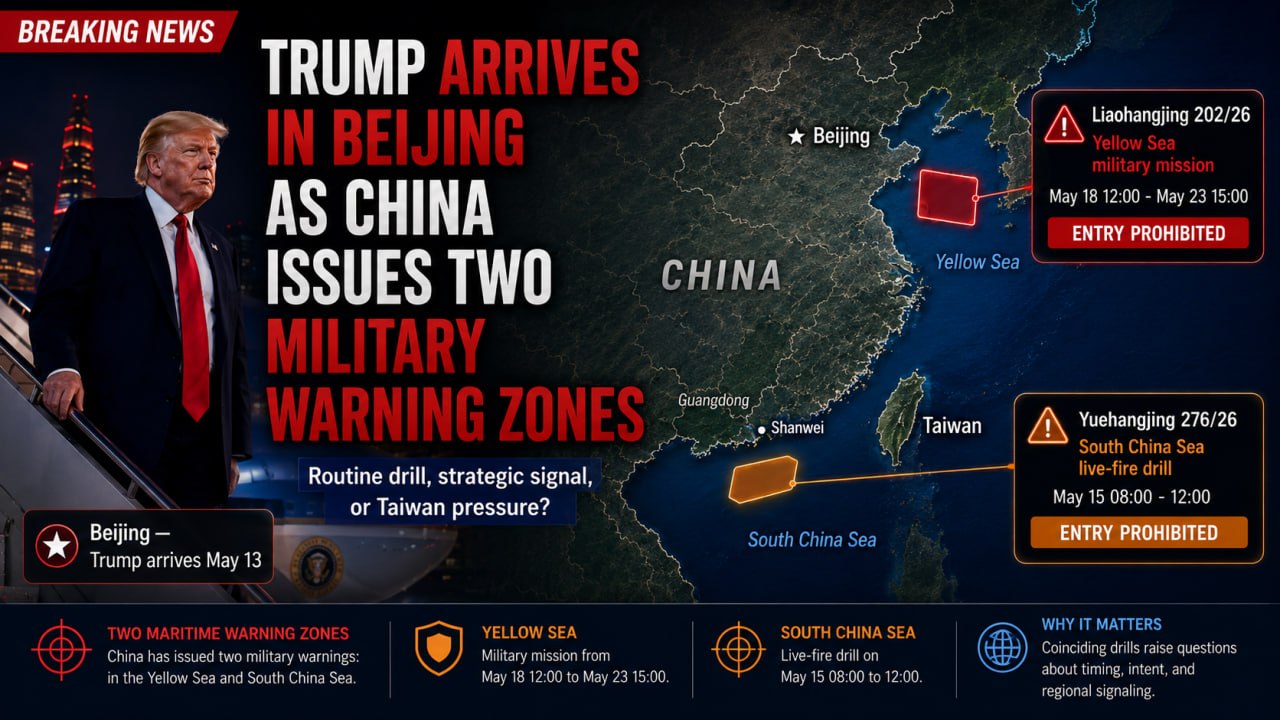
BEIJING — U.S. President Donald Trump arrived in Beijing on May 13 for a state visit to China, placing U.S.-China relations back at the center of global attention.
北京——美国总统特朗普于5月13日抵达北京,对中国进行国事访问,中美关系再次成为全球关注焦点。
China’s Foreign Ministry had previously announced that Trump would visit China from May 13 to May 15 at the invitation of Chinese President Xi Jinping.
中国外交部此前宣布,应中国国家主席习近平邀请,特朗普将于5月13日至15日对中国进行国事访问。
CCTV reported on the evening of May 13 that Trump’s aircraft had arrived in Beijing, marking the official start of the visit.
央视新闻5月13日晚报道,特朗普乘专机抵达北京,正式开启此次访华行程。
But on the same day Trump arrived, China also issued two military-related maritime navigation warnings, raising questions about Beijing’s timing and message.
但就在特朗普抵京同一天,中国也发布了两则与军事活动有关的海上航行警告,引发外界对北京时机与信号的关注。
According to the first notice provided by the China Maritime Safety Administration, live-fire training will take place in part of the South China Sea on May 15 from 8:00 a.m. to 12:00 p.m., with vessels banned from entering the designated area.
根据中国海事局发布的第一则公告,南海部分海域将于5月15日8时至12时进行实弹射击训练,相关海域禁止驶入。
According to the second notice, a military mission will be carried out in part of the Yellow Sea from May 18 at 12:00 p.m. to May 23 at 3:00 p.m., and entry into the area will also be prohibited.
根据第二则公告,黄海部分海域将于5月18日12时至5月23日15时执行军事任务,同样禁止驶入。
These notices are maritime navigation warnings, not aviation no-fly zones, but they still matter because they restrict access to specific sea areas during military activity.
这些公告属于海上航行警告,并非航空意义上的禁飞区,但由于涉及军事活动期间的特定海域管制,仍具有观察意义。
On the surface, the warnings may be routine, as Chinese maritime authorities frequently issue similar notices for live-fire training, military missions and restricted sea areas.
从表面看,这类航行警告可能属于例行安排,因为中国海事部门经常发布实弹射击、军事任务和相关海域禁入公告。
However, the timing is politically sensitive because one warning overlaps with the final day of Trump’s China visit, while the other begins shortly after his expected departure.
然而,这次的时间点具有高度政治敏感性,因为其中一则公告与特朗普访华最后一天重叠,另一则则在其预计离开中国后不久开始。
This has fueled a key question: is Beijing sending a military signal while engaging Washington diplomatically?
这引发一个关键问题:北京是否在与华盛顿进行外交接触的同时,也释放军事信号?
The Trump-Xi talks are expected to cover major issues including trade, Iran, artificial intelligence and U.S. arms sales to Taiwan.
外界预计特朗普与习近平的会谈将涉及贸易、伊朗、人工智能以及美国对台军售等重大议题。
That makes Taiwan one of the most sensitive topics surrounding the Beijing summit, even if the two maritime warning areas are not located in the core Taiwan Strait zone.
这使台湾问题成为北京峰会周边最敏感的议题之一,尽管这两处海上警戒区域并不位于台海核心区域。
For Taiwan, the concern is not only what is announced publicly, but what Washington and Beijing may discuss behind closed doors.
对台湾而言,真正令人关注的不只是公开宣布的内容,更包括华盛顿与北京在闭门会谈中可能讨论什么。
If Beijing uses military activity to frame the diplomatic atmosphere, it could be intended to remind the United States that security issues remain central to China’s agenda.
如果北京借军事活动塑造外交背景,其目的可能是提醒美国:安全议题仍是中国议程中的核心部分。
But there is currently no public evidence proving that these two maritime warnings are directly aimed at Taiwan or that they signal an imminent Taiwan Strait exercise.
但目前并没有公开证据证明这两则航行警告直接针对台湾,也没有证据显示这就是台海军演即将展开的信号。
The more cautious interpretation is that the warnings may be routine military scheduling, amplified by an unusually sensitive diplomatic moment.
较谨慎的解读是,这些公告可能是例行军事安排,只是被一个异常敏感的外交时刻放大了政治意义。
Still, the possibility of follow-up military moves after Trump leaves Beijing cannot be ignored.
不过,特朗普离开北京后是否出现后续军事动作,仍不能被忽视。
Observers will now watch whether China issues new warnings near the Taiwan Strait, whether the Eastern Theater Command releases political messaging, and whether PLA aircraft or ships increase activity around Taiwan.
接下来,外界将关注中国是否在台海周边发布新的航行警告、东部战区是否释放政治性措辞,以及解放军军机军舰是否增加在台湾周边活动。
If new restricted zones appear closer to Taiwan after the summit, the interpretation could shift from routine training to coordinated political pressure.
如果峰会后在更接近台湾的海域出现新的禁入区域,外界解读可能会从例行训练转向有组织的政治施压。
For now, the two warnings should not be overstated as proof of an immediate crisis.
就目前而言,不应把这两则公告过度解读为立即危机的证据。
But they also should not be dismissed, because military timing often carries political meaning in U.S.-China-Taiwan relations.
但也不应完全忽视它们,因为在美中台关系中,军事动作的时间点往往具有政治含义。
Trump’s arrival in Beijing is therefore not only a diplomatic story, but also a test of how far China may go in combining negotiation with military signaling.
因此,特朗普抵达北京不只是一则外交新闻,也是在考验中国会在多大程度上把谈判与军事信号结合起来。
The central question now is whether Beijing is simply maintaining its military schedule, or preparing to send a stronger message after Trump leaves.
现在的核心问题是:北京只是维持原有军事安排,还是准备在特朗普离开后释放更强烈的信号。
For Taiwan, the most important issue remains clear: peace and stability in the Taiwan Strait should not become a bargaining chip in U.S.-China negotiations.
对台湾而言,最重要的问题依然明确:台海和平与稳定不应成为美中谈判中的交易筹码。
The next few days may reveal whether these warnings were routine notices, diplomatic background noise, or the first sign of a larger regional pressure campaign.
接下来几天或许将揭晓,这些警告究竟只是例行公告、外交背景噪音,还是更大规模区域施压行动的前兆。